

Which version of a Da Vinci implementation guide is actually the version CMS is asking you to ship? If you have opened the CMS-0057-F final rule text and then opened the HL7 Da Vinci pages the same afternoon, you already know the answer is not obvious. Version pins move, IGs get republished, and the rule preamble points at named releases rather than living pages.
This piece walks through what CMS-0057-F cites, what "mandatory" means in the rule's own language, and what a payer stuck on a 2023 or 2024 IG version should do between now and the January 1, 2027 enforcement date. For broader context there is more in the FHIR fundamentals reference on our site.
What CMS-0057-F Actually References
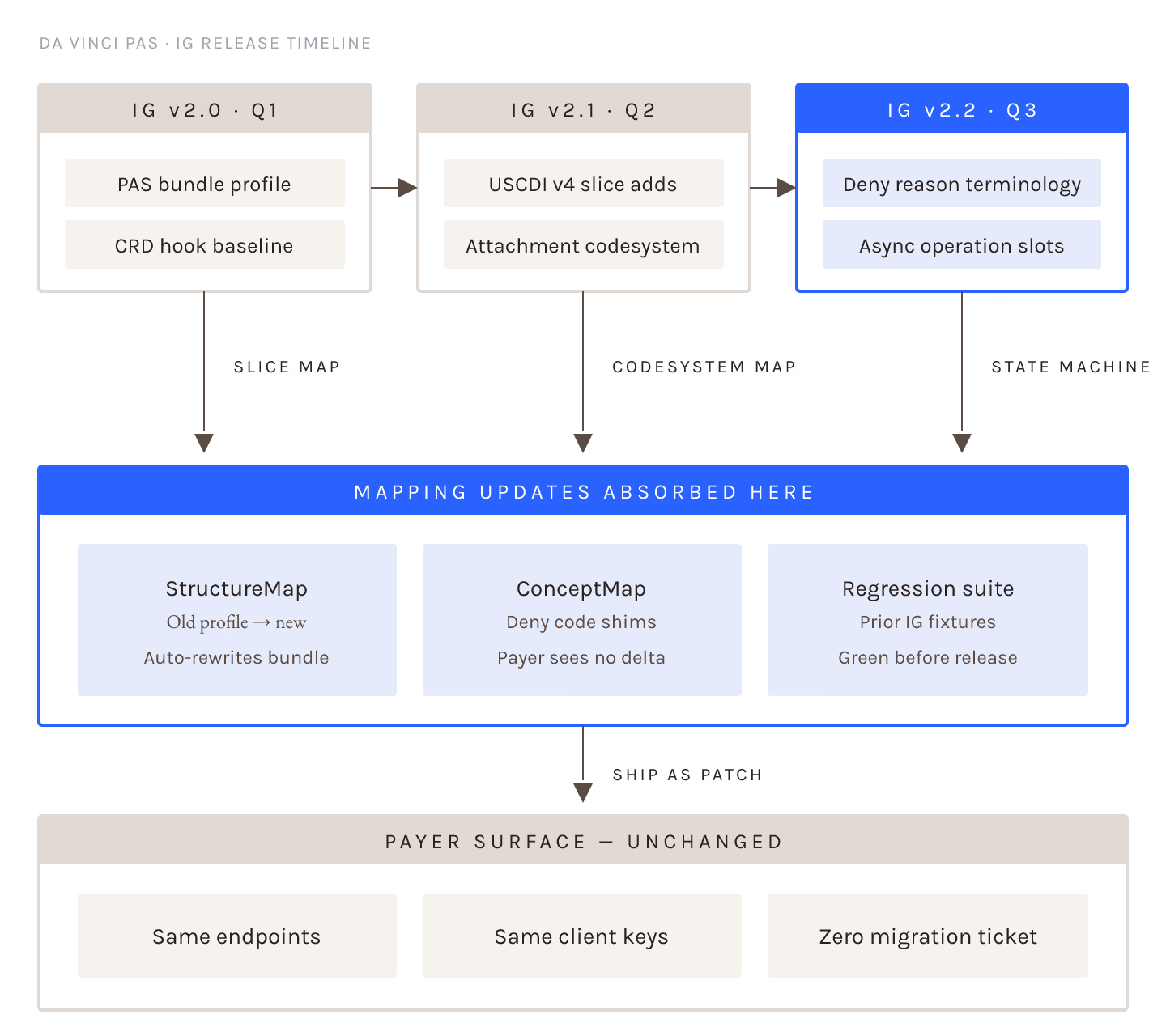
CMS-0057-F is written against a specific set of Da Vinci and PDex implementation guides, and the rule's preamble names them by title. The four APIs it mandates for impacted payers are the Patient Access API, the Provider Access API, the Payer-to-Payer API, and the Prior Authorization API. Each of those APIs maps to at least one HL7 or Da Vinci IG that CMS points at as the technical basis.
The IGs most often called out are:
- PDex (Payer Data Exchange) for the Patient Access and Payer-to-Payer flows
- PDex Plan-Net for the Provider Directory API
- US Drug Formulary for drug data exposure
- Da Vinci CRD (Coverage Requirements Discovery)
- Da Vinci DTR (Documentation Templates and Rules)
- Da Vinci PAS (Prior Authorization Support)
For DTR in particular the FHIR Questionnaire and QuestionnaireResponse resources sit right at the center, which is why payers with any legacy form tooling should read up on FHIR Questionnaire versus legacy EDC forms before scoping the work.
Mandatory Versus Recommended in Practice
The rule text distinguishes standards that a payer must conform to from newer versions that CMS "encourages". In plain reading, a payer must ship the STU release that CMS cites, and CMS accepts newer errata or ballot updates as long as they are backwards compatible with the cited version.
That leaves three practical categories:
- Mandatory baseline: the STU release named in the rule preamble
- Acceptable substitute: a later STU release that keeps profile identifiers stable
- Not sufficient by itself: a draft ballot or a CI build snapshot
The trap is category three. Some payer engineering teams pin to a build.fhir.org snapshot because it has a bug fix they need. That snapshot is not a released IG. It is a moving target that can drift out of conformance overnight.
What Happens If You Are Stuck on a Pre-2026 Version
Plenty of payers went live on early PDex or CRD releases years ago and have not repinned. If you are on a version older than the one CMS names, the risk is that testing tools, connectathon partners, and eventually CMS audit tooling will flag your endpoints as non-conformant even if the payloads look correct. Value set slices and profile constraints tighten with every release.
The engineering tax of following IG updates is real. Maintenance of the Da Vinci implementation guides is a recurring cost every quarter, and some payer platforms like Payerbox from Health Samurai absorb that IG-tracking work on their side, so the payer team focuses on business rules and coverage logic rather than reprofiling patient resources.
For payer teams also modernizing their intake and prior auth forms in parallel, the complete guide to FHIR form builders for clinical research in 2026 has a useful checklist that applies well beyond research.
Timeline You Can Actually Plan Against
Working backwards from January 1, 2027 the milestones a payer program should hit look like this:
- Q3 2026: freeze IG version pins, publish CapabilityStatement
- Q4 2026: connectathon or third-party conformance testing against the pinned versions
- December 2026: parallel production run for Patient Access and Provider Access
- January 1, 2027: Prior Authorization API live and compliant
- Q1 2027: reporting endpoints for PA metrics operational
- Q2 through Q4 2027: quarterly IG republish check, errata review, and re-attest
The teams that hit that timeline treat the IG version log as a recurring artifact rather than a one-time reading. That is the honest posture for a rule this active.
Sources
- HTML, CMS.gov FAQ - Standards and Implementation Guides (recommended Da Vinci PDex Plan-Net STU 1.1.0, CRD STU 2.0.1, DTR STU 2.0.0, PAS STU 2.0.1 named in CMS-0057-F)
- PDF, Federal Register vol 89 no 27, Feb 8 2024 - CMS-0057-F final rule text with 42 CFR 431.60/431.61/431.80 API requirements and Jan 1 2027 enforcement dates
- HL7 canonical - Da Vinci Prior Authorization Support (PAS) FHIR IG v2.1.0 (STU2.1) landing page, the release cited by CMS for the Prior Authorization API